Sunday, November 27, 2011
Paki soldiers mowed down by ally USA - CIA is in every country, yours too.
24? 26? dead.. number killed as high as 28? 12 soldiers mamed badly. Remember a CIA contractor who shot dead two Pakistanis in Lahore? USA brings modern western democratic methods to the world. Fighting muslimhood? The anit-capitalist religion!!
The helicopters attacked two checkpoints around 1,000 feet apart from each other, one of them twice.
Pakistan said Nato helicopters and fighter aircraft fired unprovoked overnight Friday-Saturday on two army border posts, killing 24 to 26 troops and wounding 13, adding that Pakistani troops had returned fire.Nato's International Security Assistance Force (ISAF), Brigadier General Carsten Jacobson "It's highly likely that this close air support, called by the ground forces, caused the casualties,"
The incident took place in a village of Salala, which is an area bordering the Kunar province of Afghanistan.
And located in the Tehsil Bayzai area of Mohmand Agency on the Pak-Afghan border
American forces were given 15 days to vacate the remote Shamsi airbase, secretive air base reportedly used by CIA drones which was secretly turned over to them after the 9/11 attacks
Two years ago, following a similar border incident that killed two Pakistani soldiers after they were mistaken for insurgents, Pakistan closed the border for 10 days. The border was reopened after the United States formally apologised.
Pakistan had previously said it would expel the Americans from Shamsi, which was never carried out. This time it seemed serious.
Most drone flights now take place from an airbase at Jalalabad in Afghanistan.
Most recently, the Pakistani ambassador to the U.S. resigned amid claims he engineered a memo to Washington asking for its help in reining in the military in exchange for a raft of pro-American policies. He has denied any connection to the memo, but was replaced earlier this week by democracy activist Sherry Rehman. His successor, Sherry Rehman, has yet to arrive in Washington.
Pakistan has also lodged protests in NATO headquarters in Brussels.
The military said funerals will be held at 9:30 am Sunday in the northwestern city of Peshawar
Nato troops frequently carry out operations against Taliban insurgents close to the border with Pakistan, which in many places is unmarked, although the extent to which those operations are coordinated with Pakistan is unclear.
Afghan and US officials accuse Pakistani troops at worst of colluding with the Taliban or at best of standing by while insurgents fire across the border from Pakistani soil, often in clear sight of Pakistani border posts.
At the same time Pakistan, battling its own Taliban insurgency in the northwest and dependent on billions of dollars in US aid, gives the US-led war effort in Afghanistan vital logistics support.
Key questions remain unanswered about what exactly happened in Mohmand district, just hours after General John Allen, the US commander in Afghanistan, discussed coordination with Pakistan's army chief General Ashfaq Kayani.
Wednesday, November 23, 2011
JFK murder in Dallas - SALON writes and understands (a littlebit more every year)
From the Moorman Polaroid
Mary Ann Moorman best known for her photograph capturing the presidential limousine a fraction of a second after the fatal shot.
Moorman Polaroid, enhancement of the corner of the rotunda wall
THE BEST BOOK about the JFK murder. It explains the "WHY" .. finally.
see here
http://u2r2h-documents.blogspot.com/2011/11/new-best-jfk-book-catholic-but-full-of.html
Salon writes a reasonable article, but magnitude of the crime and the fact that the CIA did it is not mentioned properly. 9/11 is a direct result of the rogue agencies JCS ONI CIA that the USA MUST reign in, or forget about democracy.
SALON WRITES:
The holy grail of the JFK story
Seven steps to unlocking the historical truth about the assassination in Dallas
President John F. Kennedy and First Lady Jackie Kennedy arrive in Dallas on November 22, 1963. (Credit: JFK Presidential LIbrary and Museum)
Topics:JFK, conspiracy theories
Two years from today Americans will observe the 50th anniversary of the assassination of President John F. Kennedy. It is likely to be a moment of national introspection, as well as an opportunity to complete the historical record of one of the most painful days in American history. Yet, incredibly enough, the Central Intelligence Agency is likely to object to declassifying all of its records related to the murder of the 35th president in Dallas on Nov. 22, 1963. The question on the 48th anniversary of the tragedy is whether the CIA's extreme claims of JFK secrecy — reiterated in federal court filings this year — will be allowed to stand.
The tediously unresolved case of the assassinated president never quite goes away as some would wish. Stephen King's new book, "November 22, 1963," is yet another imaginative retelling of a critical day in American history, a densely layered epic that appeals to the enduring impulse to understand how the president of the United States was gunned down in broad daylight, and why no one was ever brought to justice for the crime.
The official story, still defended by an articulate minority, was heard in a National Geographic special last weekend. Kennedy's death was said to be the tragic result of the psychotic actions of one individual. But as the NatGeo special demonstrates, the defense of that perspective is growing more eccentric. The program offered a novel interpretation of the photographic and forensic evidence from historian Max Holland that has been cogently addressed by independent researchers and is not shared by many JFK scholars, whether pro- or anti-conspiracy. Holland's theory merely confirms what has long been obvious to many: There are a lot implausible theories of who killed JFK, and the notion that a "lone nut" was solely responsible is one of them.
More likely, Kennedy was ambushed by enemies who sought to avoid detection. That is what JFK's widow, Jacqueline, and his brother Robert believed. As David Talbot demonstrated in his 2007 book "Brothers," Bobby Kennedy concluded within hours of the gunfire in Dallas that his brother had been killed by anti-Castro Cubans. For the rest of his life, RFK never abandoned a conspiratorial interpretation of his brother's death. (Full disclosure: Talbot is my boss and friend.)

The story is well-documented. Within a week of the assassination, RFK and Jackie Kennedy sent a friend to Moscow with a message for the leadership of the Soviet Union. As historians Aleksandr Fursenko and Tim Naftali reported in their 1999 book on the Cuban missile crisis, "One Hell of a Gamble," Bobby and Jackie wanted the Soviet leadership to know that "despite Oswald's connections to the communist world, the Kennedys believed that the president was felled by domestic opponents." This finding is worth repeating on the 48thanniversary of JFK's death: Jackie and Bobby Kennedy "believed that the president was felled by domestic opponents."
Naftali, now the director of the Richard Nixon Presidential Library in California, told me in an email that he and his co-author learned the story from a Soviet diplomat, Georgi Bolshakov, and found his written account of Bobby and Jackie's message in the Soviet archives. In that message Bobby and Jackie sought to assure the Soviet leadership that they did not believe that Oswald acted at Castro's behest. The clear implication of the message was that Bobby and Jackie held the American right, not the international left, responsible for the crime in Dallas. "I was a little surprised what little reaction the … story got," Naftali wrote.
No doubt inadvertently, the National Geographic JFK special fostered a reassuring yet false view of American history: that there is little reason to doubt the official story blaming a "lone nut." In fact, Bobby and Jackie were not alone in suspecting conspiracy in Dallas. At the time, 60 percent of Dallas residents suspected a plot. JFK's successor, Lyndon Johnson, privately suspected a plot emanating from JFK enemies in Cuba or Vietnam. In Havana, Fidel Castro, a man whose peaceful dotage is proof positive he knows something about detecting CIA conspiracies, concluded JFK had been killed by a right-wing faction within his own government. More recently, University of Virginia professor Larry Sabato, a mainstream political pundit and author of a forthcoming book on the legacy of Kennedy's assassination, has joined critics of the official JFK story.
"Critical documents that could explain more about what happened are being hidden, and aggressively so," Sabato told me in an email. "It's no wonder a large majority of Americans believe in various conspiracy theories. There's plenty to be suspicious about."
Sabato has company in academia. There is a growing scholarly consensus that JFK was killed by a conspiracy. Since 2000, five tenured historians at U.S. universities have published scholarly studies that addressed the causes of JFK's death. Four of the five concluded there was a conspiracy (though they did not all agree on who was responsible).
Thus the enduring conundrum of JFK's assassination story. While a confident minority in the opinion-making class dismisses any consideration of conspiracy, the majority of the public is left to ponder a bewildering array of theories without much guidance about what is actually the most plausible explanation of how the president came to be killed.
As someone who has written about the JFK story for 28 years without advocating any "theory" of the case, I recommend seven steps for those who want to understand the causes of JFK's death.
Step 1: If you are looking for evidence of a JFK conspiracy, do as prosecutors and law enforcement do: start in the middle and work your way up.
It is tempting but foolish to start your personal JFK investigation by seeking to identify the gunmen or the intellectual authors of the crime. Start by identifying the people who were less involved and use them to identify those who were more complicit.
As a reporter for the Washington Post, I started by investigating those employees of the CIA most knowledgeable about the accused assassin, Lee Harvey Oswald. Over the years, I found a dozen or more CIA officers who had sent or received cables about Oswald while President Kennedy was still alive. I interviewed some of them, as well as their surviving descendants, friends and associates. My goal was to answer the investigative reporter's basic question: What did these CIA people know about Oswald? And when did they know it?
Step 2: Understand the intense psychological resistance to Step 1.
Some people cannot distinguish between serious journalism about the JFK story and the meretricious conspiracy theories peddled by the 9/11 truthers. This is unfortunate. Such resistance to conspiratorial thinking, while sometimes useful, too often rationalizes a kind of anti-journalistic defensiveness that actually prevents discussion of the JFK story. CRAP!! 9/11 was another CIA/JCS inside job, full stop. It will take another 40 years but you will come to realize that, too.
Talk show host Chris Matthews, a decent liberal and huge fan of JFK, grows agitated at the suggestion that a serious person might disagree with the official story. Cass Sunstein, an otherwise sane senior advisor to President Obama, has proposed that the government infiltrate JFK conspiracy chat groups to dispel the allegedly dangerous and delusional ideas discussed there. Former New York Times editor Bill Keller recently admitted he deletes all emails on JFK assassination without reading them, but offhandedly noted, "There's always has been something fishy about that assassination."
In the face of such denial and indifference, the interested citizen must turn to books such as David Kaiser's "The Road to Dallas," and James Douglas' "JFK and the Unspeakable" to get the latest evidence on JFK's assassination. Fortunately, the public can now visit quality websites, such as that of the Mary Ferrrell Foundation — which has the largest online collection of JFK records – JFKLancer, and the home page of professor John McAdams. The sites seek to identify the most reliable information about the JFK story and encourage debate about the key questions, a chore most U.S. news organizations have long disdained.
Step 3: If you want to get into the conspiratorial weeds, educate yourself on Operation Northwoods.
This is story that the likes of Chris Matthews and Bill Keller don't care to engage too closely. It emerged from a wealth of new information released as a result of Oliver Stone's all-too-believable 1992 movie "JFK." Among the new records were a batch of long-secret records about a Pentagon scheme known as Operation Northwoods. These documents showed that by mid-1963, U.S. military planners had developed a uniquely devious approach to advancing their preferred policy of "regime change" in Cuba. The Northwoods concept called for CIA operatives to mount "terrorist" actions on U.S. soil that would then be blamed on the Castro government. By framing Cuba as an irresponsible and violent actor, the U.S. could justify an invasion of Cuba — something that the Joint Chiefs of Staff unanimously favored. JFK emphatically rejected such pretext operations in a tense meeting with the JCS in March 1962. Yet the Northwoods planning continued, with CIA input, through the summer of 1963, according to the documents.
The Northwoods documents lend credence to Stone's depiction of Kennedy's death as the work of a high-level national security cabal that sought to blame the crime on a communist to avoid detection. That sort of scenario was not the ex post facto invention of a Hollywood screenwriter. It was Pentagon policy circa Nov. 22, 1963.
Step 4: Understand the CIA's role in the JFK story as it emerges from files declassified since Stone's movie.
The new JFK files do not prove there was a conspiracy but they do prove this: There was a group of senior Agency officers who knew much more about Lee Harvey Oswald in late 1963 than they ever said publicly or shared privately with colleagues.
In Langley those knowledgeable about Oswald while JFK was still alive included James Angleton, the chief of the Agency's Counterintelligence (CI) Staff. Angleton was a protean character whose penetrating intellect and obscure exploits have inspired a small library of books and several Hollywood movies. He was also an alcoholic, ultra-right-wing paranoiac who ran covert operations with no oversight from anyone. At least three of his closest aides, Jane Roman, William J. Hood and Birch D. O'Neal received pre-assassination intelligence on Oswald.
In Mexico City, Winston Scott, the trusted chief of the CIA's Mexico City Station (the subject of my book "Our Man in Mexico"), his aide Anne Goodpasture, and his not-so-trusted deputy David A. Phillips oversaw the surveillance of Oswald's visit there just six weeks before JFK was shot dead.
In the CIA's Miami station, the chief of the psychological warfare branch, George Joannides, was running a network of Cuban agents who exposed and denounced Oswald for his pro-Castro political activities in New Orleans.
Most of these officials were not involved in any plot to kill JFK. I interviewed Roman, Hood and Goodpasture at length and came away certain they had nothing to do with any JFK conspiracy. I wrote a book about Win Scott and came to the same conclusion. As for Jim Angleton and David Phillips, I presume their innocence but have much less certainty about it.
The newly declassified CIA's records show that Angleton's CI staff kept track of Oswald constantly from October 1959 to November 1963. At Angleton's direction, more than 40 reports about Oswald's travels in the communist world, his family life and his political views were funneled to a secretive office in the Counterintelligence Staff known as the Special Investigations Group. The SIG was headed by Birch O'Neal, a loyal aide who had served as CIA station chief in Guatemala during the CIA-sponsored coup d'etat in 1954.
The CIA files show that the pace of intelligence gathering around Oswald quickened in mid-1963. In August 1963, Joannides' assets started reporting on Oswald's antics in New Orleans. When Oswald visited the Cuban consulate in Mexico City a few weeks later, he was surveilled by Phillips. When CIA and FBI reports on Oswald were sent to the SIG, they were signed for, and read by Angleton's staff. No, this isn't Internet fable: The routing sheets with their signatures can be found in the National Archives, and Roman and Hood confirmed their authenticity in separate interviews.
Six weeks after Angleton's aides reviewed the Oswald file, JFK was shot dead and Oswald was arrested for the crime. These CIA officers did not investigate and conclude that Oswald had acted alone. Some, including Phillips and Joannides, took actions to insure that blame for the crime of Dallas would fall on Cuba. Others, like Scott, scrambled to learn more about Oswald. Angleton blandly disavowed his long-standing interest in Kennedy's accused killer and concealed the paper trail that proved it.
Step 5: See the crime of Dallas as people in the CIA saw it.
In the course of writing my book about Win Scott, a math teacher from rural Alabama who transformed himself into one of the best CIA officers of his generation, I found that he knew there was something very wrong with the Agency's handling of information about Oswald.
Scott knew that deputy CIA director Dick Helms had lied to the Warren Commission about the Agency's pre-assassination surveillance of Oswald. And he learned that Angleton, a longtime friend, had kept him "out of the loop" on the latest intelligence about Oswald in October 1963.
Scott also harbored doubts about his deputy Phillips, the chief of the agency's covert operations against the Castro government at the time. After Kennedy's assassination, Scott downgraded Phillips on his job evaluation, and came to question his reporting on Oswald. When Scott privately aired some of his misgivings to a colleague in the British intelligence service a few years later, Angleton intercepted the message and sent a warning to Scott: Do not talk about JFK's assassination with anyone.
In the upper echelons of the CIA, Lee Harvey Oswald was not regarded as a "lone nut." At the level of Jim Angleton, Win Scott and David Phillips, Oswald was regarded as an extremely sensitive operational matter. It is inevitable that historians will view him the same way.
Step 6: Understand how U.S. national security operatives organized political assassinations in the 1960s and 1970s.
David Phillips was still alive when I arrived in Washington in the 1980s. He had retired from the Agency to found a pro-CIA lobbying group, the Association of Foreign Intelligence Officers. Phillips was a charming, cunning man, and a lively writer, even penning the occasional column for the Washington Post Outlook section where I later worked. One colleague at the Post, well-versed in the intelligence world, once told me that he had gotten to know Phillips. "He wasn't the type" to be involved in a plot against JFK, this colleagues assured me.
A couple of years later, the nonprofit National Security Archive obtained via the Freedom of Information Act (FOIA) a cache of CIA records about a notorious political assassination in October 1970. The documents showed President Richard Nixon had ordered the CIA to take action to prevent leftist Salvatore Allende from assuming the presidency of Chile. The assignment was given to a task force directed by Phillips, by then one of the most senior operative in the Agency's Latin America division, which identified a target: Gen. Rene Schneider, the commander in chief of the Chilean armed forces. Schneider's crime: He had decided that Allende, winner of a recent election, should take office.
If you want to know how the CIA went about killing a political enemy at that time, study the records of this operation. Phillips brought in a team of four Agency operatives to organize a group of Chilean co-conspirators who were supplied with "three sterile 45 caliber machine guns." The Agency's operatives consulted with the Chileans about when to act and how they might justify the crime. The conspirators ambushed Schneider's car in traffic, smashed the window with a sledgehammer, and shot him with the U.S.-supplied guns. After Schneider died a day later, Chile scholar Peter Kornbluh notes that Phillips co-authored a cable saying the CIA station had "done [an] excellent job of guiding [the] Chileans."
Perhaps David Phillips was not the type to participate in the assassination of a U.S. president. But he did orchestrate the murder of a Latin American commander in chief. And his operational expertise in political assassination was never disclosed to congressional JFK investigators in the late 1970s.
Of course, this appalling episode in 1970 does not prove that Phillips participated in a JFK conspiracy in 1963. But if the CIA is interested in quelling long-standing conspiratorial speculation about Phillips, it should practice full disclosure to set the record straight.
Step 7: Return to Step 1; start in the middle of the alleged conspiracy and work your way up.
Thanks to CIA records declassified since 1998, we now know much more about a key aspect of the JFK story: the Agency's underappreciated role in spreading the story that JFK had been killed by a communist.
As David Phillips mounted covert operations against the Castro government in the summer and fall of 1963, he was assisted by George Joannides, a dapper, 40-year-old spy from New York City. In Miami Joannides handled the CIA's contacts with a network of anti-Castro Cuban students whom Phillips had recruited on the campus of the University of Havana before Castro's revolution. Within hours of JFK's murder in Dallas, Joannides' agents got his approval to alert reporters to the fact that Kennedy's accused killer was a member of a pro-Castro group called the Fair Play for Cuba Committee. Their revelation generated headlines in the Washington Post, New York Times and dozens of newspapers across the country asserting what some still believe: JFK was killed by a pro-Castro communist.
We can now see that the aftermath of JFK's assassination bore an eerie resemblance to the schemes envisioned in Operation Northwoods: After a terrible crime was committed in the United States, CIA operatives covertly sought to arrange for the blame to fall on Castro, the better to justify a U.S. invasion.
Was the CIA's post-assassination propaganda about Oswald (to use Bill Keller's word) "fishy"? The likes of Chris Matthews and Cass Sunstein (and even Keller himself) may try to dismiss the thought. But Jackie and Bobby Kennedy could not. They "believed that the president was felled by domestic opponents."
It certainly seems fair to ask: Did Angleton, Phillips or others who were well-informed about Oswald before the assassination simply misunderstand and underestimate him as he made his way to Dallas with a gun? Or is it possible that one or more of them participated in some kind of covert operation — sponsored by the Agency or the Pentagon — to manipulate Oswald before Nov. 22, 1963, for the sake of advancing the U.S. policy of overthrowing Castro?
Thanks to CIA secrecy, such questions cannot be answered.
One view is that there is not much more to learn about the CIA and the JFK assassination. On the National Geographic show, Max Holland was asked if there was a "holy grail" of JFK assassination researchers. He cited Oswald's tax records, which remain private at the request of his widow, Marina, who still lives in Texas (and believes her first husband innocent of JFK's murder).
I think most published JFK authors would find Holland's assessment too narrow. There are other important JFK records that remain at large. Diplomatic historian David Kaiser has identified several. Researcher William Kelly has shown that Office of Naval Intelligence (which had responsibility for tracking Oswald, an ex-Marine) possesses assassination-related files that it has never released.
James Lesar, a veteran Freedom of Information Act litigator in Washington (and, more full disclosure, my pro bono attorney), has a larger holy grail: the 50,000-plus pages of unreleased JFK assassination records now held by the National Archives. Much of this material has been classified as "Not Believed Relevant" to JFK's assassination — and most of it is. But within the NBR records, and elsewhere in CIA archives, are still-secret files of some of those officers who were knowledgeable about Oswald before Kennedy's murder — and they are quite relevant to understanding how JFK was killed. At least 1,000 pages of such material remains secret.
How do we know? In 2003 I sued the CIA for the records of George Joannides, a secondary character in the JFK story. Eight years later, the Agency is still fighting the release of some 330 records on him, a legal defense that the New York Times aptly described in 2009 as "cagey." Agency lawyers are scheduled to appear in federal court later this year to argue that none of this antique material can be made public in any form — supposedly for reasons of "national security."
With Lesar's help, I discovered that the National Archives retains 605 pages of CIA records about David Phillips in the JFK Assassination Records Collection in College Park, Md. The Archives also has 222 pages about Birch D. O'Neal, Angleton's aide who received reports on Oswald regularly between 1959 and 1963. The Agency says it will not release the Phillips and O'Neil material until at least 2017.
(Anyone can view what is known about these files by searching the National Archive's JFK Assassination Records Collection here. Enter "David Phillips" or "Birch O'Neal in the first search field and "NBR" in the second. Then click on "Display Search Results." To view more details about the withheld files, click on "Display All/Selected Hits.")
These records can and should be made public by the 50thanniversary of JFK's death in 2013. The National Archives is now embarked on a crash course to declassify some 400 million pages of classified U.S. government records. Two years ago, Michael Kurtz, a senior official at the Archives, said in a public hearing in Washington that the still-secret JFK assassination records would be a priority for release by 2013, a position that the Archives has since backed off. In the risk-averse culture of Washington, there is little appetite for full JFK disclosure. President Obama's laudatory executive order on open government has proven entirely ineffectual in the case of assassination-related records.
Thus on the 48th anniversary of the Dallas tragedy, we have the usual dispiriting situation: the public remains confused, and the prospects for full disclosure are not bright. We collectively wonder if there is a "holy grail" of the JFK assassination story and the CIA refuses to share. The courts are acquiescent, and what remains of the press cannot be bothered to address the obvious questions.
Nonetheless, I prefer to experience Nov. 22 as a day of hard-won hope. Public interest in JFK and Jackie Kennedy (and to a lesser extent, Bobby) remains intense and widespread. Thanks to the Internet, public access to the full historical record of the JFK assassination story has never been greater. Many people sense that JFK died for a reason and want to know what it was. We're not delusional. We're realistic. We want the real history of our country.
Jefferson Morley is the Washington editor of Salon.
THE BEST BOOK about the JFK murder. It explains the "WHY" .. finally.
see here
http://u2r2h-documents.blogspot.com/2011/11/new-best-jfk-book-catholic-but-full-of.html
interesting ZAPRUDER film analysis
http://www.youtube.com/watch?v=5Am4qdl9PTA << VERY GOOD
http://www.youtube.com/watch?v=VJ0s9kspL4g
Tuesday, November 22, 2011
USA: 100 years of prison time - for NON VIOLENT PROTEST
Theresa will face a federal trial next year – her second trial for such actions at Fort Benning. Theresa also carried her protest onto Fort Benning in 2008, an act for which she served two months in federal prison. Protests against the SOA/WHINSEC began 21 years ago; since then, over 300 people have been sentenced and have collectively served over 100 years of prison time for nonviolent civil disobedience.
Before carrying her protest onto the base yesterday, Theresa addressed thousands of human rights activists at the gates of Fort Benning for the November Vigil. Here are excerpts from her speech from the stage:
"[…] I am choosing civil disobedience because of the lawless acts promoted by the School of the Americas and carried out all over the world. These human rights crimes are unfitting of a so-called "World Super Power." I've never been big on shame, even though I'm Catholic. But if that's what it takes to get Congress to close WHINSEC (SOA) and all other for-profit consulting gigs our government is financing at our expense... I'm not above invoking shame. Like the hundreds of thousands of protestors who've come before me. I'm in good company. […]
Our message is not being heard in Congress, our lawmakers have been purchased by other priorities, so youth and students in the movement ask for you to help us in the Court of Public Opinion and go online to the Daily Show's Facebook page, register in for their Forum http://forums.thedailyshow.com/ . Request that Father Roy be invited onto the Daily Show, and the Colbert Report. Don't stop until we get Roy's voice into the media mainstream, Hardball with Chris Matthews, Rachel Maddow, Keith Olbermann and the Sunday morning circuit. Don't let my civil action go to waste."
Father Roy Bourgeois has spent over four years in federal prison for peacefully crossing into Ft. Benning
Chris Takes Action to Connect the Struggles
Chris Spicer from Chicago, Illinois, crossed the police barricade at Friday's protest against the Stewart Detention Center, the largest privately owned detention center in the United States. Chris engaged in civil disobedience in solidarity with the immigrants detained within the prison walls. Many of those incarcerated came to the United States from Latin America because of the violence carried out by SOA graduates against civilian populations in their countries. Chris, who was recently released after serving a six-month sentence for crossing the line at the 2010 Vigil to Close the School of the Americas, was brought before Judge Wayne Ammons, who set the bond for this criminal trespass charge exorbitantly high at $5,000. Responding to news that Stewart Detention Center detainees were fasting to commemorate this fifth annual vigil at the gates of the Stewart facility, Chris announced that he too would be fasting, "to purify this unjust system. The SOA and inhumane immigration policies are part of the same racist system of violence and domination." Georgia Detention Watch organizer Anton Flores, from the Alterna Community, was wrongfully arrested at the close of Friday's action, after media and legal observers had left. Despite video evidence proving Anton did not trespass, the police refused to stop harassing him, and only after the evidence was presented to Judge Ammons were his charges dismissed. Chris' bond has been reduced to $1,500 at yesterday's arraignment and the SOA Watch Legal Collective posted bail for him on Monday, November 21. He is facing charges for criminal trespass.
Ssend a message of support to Chris as he prepares to put the broken immigration system on trial in state court.
chrisweloveyou {a=t} gmail.com
Jonathan and Isaac Confront Border Patrol Officers in Alabama
We were joined by many undocumented immigrants at the gates of Fort Benning this year. We stood together to challenge the unjust and racist policies of the U.S. government, to close the School of the Americas and to win justice for all. Jonathan Pérez, an undocumented youth from California was scheduled to speak on the Saturday evening panel dicussion at the Columbus Convention Center but he could not, because he is incarcerated. On November 10, Jonathan Pérez and Isaac Barrera, two undocumented immigrants from California, entered a Border Patrol office in Mobile, Alabama and told agents they were undocumented. Theirs was a strategic move organized by the National Immigrant Youth Alliance and DreamActivist.org to prove that away from the media spotlight and contrary to its public line on its deportation policies, the Obama administration is still intent on deporting the very people it claims not to have any interest in removing from the country, including young people with no criminal convictions, eligible for the DREAM Act.
Watch this video, released over the weekend, as Pérez confronts Border Patrol officers, and courageously announces his status after telling them how disgusted he is with Obama's deportation agenda.
"We're exercising our power and showing that we can do something about this," Pérez told Colorlines last week. "We can challenge the system, and when we do, the system falls apart and the contradictions begin to show."
2005 Thomas Merton Award
Roy Bourgeois is an American activist. He was ordained a priest in the Maryknoll order of the Roman Catholic Church and is founder of the human rights group SOA Watch or the School of the Americas Watch.[1]
Father Bourgeois was excommunicated latae sententiae for his participation in a women's ordination ceremony in August 2008.
1972-1975 Fr. Bourgeois spent five years in Bolivia aiding the poor before being arrested and deported for attempting to overthrow Bolivian dictator General Hugo Banzer.
1980 Fr. Bourgeois became an outspoken critic of US foreign policy in Latin America after four American churchwomen, Sister Maura Clarke, Jean Donovan, Sister Ita Ford, and Sister Dorothy Kazel, were raped and killed by a death squad consisting of soldiers from the Salvadoran National Guard.
1990 Fr. Bourgeois founded the School of the Americas Watch or (SOA Watch), an organization that seeks to close the School of the Americas, renamed Western Hemisphere Institute for Security Cooperation (WHINSEC) in 2001, through nonviolent protest.
1998 Fr. Bourgeois testified before a Spanish judge seeking the extradition of Chile's ex-dictator General Augusto Pinochet.
2008 In August 2008, Fr. Bourgeois participated in and delivered the homily at the ordination ceremony of Janice Sevre-Duszynska, a member of Womenpriests, at a Unitarian Universalist church in Lexington, Kentucky.[4] Fr. Bourgeois received a 30 days' notice as of October 21, 2008 regarding possible excommunication for this action. He was excommunicated latae sententiae.[4]
2011 On March 18, 2011, Fr. Bourgeois was given a letter from the Maryknoll Fathers and Brothers notifying him that he had 15 days to recant his support for women's ordination or he would face expulsion from the order.[5] 157 Catholic priests have signed a letter that supports his priesthood and his right to conscience. It was delivered on 22 July to the Superior General Fr. Edward Dougherty.
Fr. Roy Bourgeois has spent over four years in federal prison for peacefully crossing into Ft. Benning. He and over 240 peace activists have been tried and jailed for peacefully demonstrating at the gates of the WHINSEC, or School of the Assassins as it's referred to by the activists.
Thomas Merton Award
Award recipients
1972: James P. Carroll
1973: Dorothy Day
1974: Dick Gregory
1975: Joan Baez
1976: Dom Hélder Câmara
1977: Dick Hughes
1978: Bishop John Harris Burt & Bishop James Malone
1979: Helen Caldicott
1980: William Winpisinger
1981: The people of Poland
1982: Archbishop Raymond Hunthausen
1983: not awarded
1984: Bernice Johnson Reagon
1985: Henri Nouwen
1986: Allan Boesak
1987: Miguel D'Escoto
1988: Daniel Berrigan
1989: Comrades of El Salvador & Elizabeth Linder
1990: Marian Wright Edelman
1991: Howard Zinn
1992: Molly Rush
1993: Reverend Lucius Walker
1994: Richard Rohr OFM
1995: Marian Kramer
1996: Winona LaDuke
1997: Ron Chisom
1998: Studs Terkel
1999: Wendell Berry
2000: Ronald V. Dellums
2001: Sister Joan Chittister
2002: Bishop Leontine T. Kelly
2003: Voices in the Wilderness
2004: Amy Goodman
2005: Reverend Roy Bourgeois
2006: Angela Davis
2007: Cindy Sheehan
2008: Malik Rahim
2009: Dennis Kucinich
2010: Noam Chomsky
2011: Vandana Shiva
Thursday, November 17, 2011
Cartoons and info about the money system
is created is so simple that the mind is repelled."
Money is loaned into existence. Conversely, when loans are paid back,
money 'disappears.'
There is a federal rule that allows banks to loan out a proportion, a
fraction, of the money they have on deposit to others. In theory,
banks are allowed to loan out up to 90% of what people have on deposit
with them. Because banks retain only a fraction of their deposits in
reserve, the term for this process is "fractional reserve banking."
John Kenneth Galbraith. He taught at Harvard University for many years
and was active in politics, serving in the administrations of Franklin
D. Roosevelt, Harry S. Truman, John F. Kennedy, and Lyndon B. Johnson;
and among other roles served as United States Ambassador to India
under Kennedy.
He was one of a few two-time recipients of the Presidential Medal of Freedom.
Leaving aside for now where this money comes from, suppose a person
walks into town with $1000, and, luckily, a brand new bank with no
deposits has just opened up. The $1000 is deposited in the bank, and
now the person has a $1000 asset (their bank account) and the bank has
a $1000 liability (the very same bank account).
Now, there's a rule on the books, a federal rule, that allows banks to
loan out a proportion, a fraction, of the money they have on deposit
to others. In theory, banks are allowed to loan out up to 90% of what
people have on deposit with them, although, as we'll see later, the
actual proportion is much closer to 100% than 90%. Nonetheless,
because banks retain only a fraction of their deposits in reserve, the
term for this process is "fractional reserve banking."
Back to our example. We now have a bank with $1000 on deposit, and
banks do not make money by holding on to it – rather, they make their
living by borrowing at one rate and loaning at a higher rate.
Since any bank can loan out up to 90%, the bank in our example manages
to locate a single individual that wants to borrow $900.
This borrower then spends that money by giving it to another person,
perhaps his accountant, who, in turn, deposits it in a bank. Now it
could be the same bank, or a different bank, but that really doesn't
change how this story gets told at all.
With this new deposit, the bank has a fresh $900 to work with, and so
it gets busy finding somebody who wants to borrow 90% of that amount,
or $810.
And so another loan, this time for $810, is made, which gets spent and
redeposited in the bank, meaning that a brand new, fresh deposit of
$810 is available to loan against. So the bank loans out out 90% of
$810, or $729, and so it goes, until we finally discover that the
original $1000 deposit has mushroomed into a total of $10,000.
Is this all real money? You bet it is, especially if it's in your bank
account. But if you were paying close attention, you'd realize that
what we've actually got here are three things. First, we've got $1000
held in reserve by the bank, $10,000 in total in various bank
accounts, and $9000 dollars of new debt. The original $1000 is now
entirely held in reserve by the bank, but every new dollar, all $9,000
of them, was loaned into existence and is "backed" by an equivalent
amount of debt. How's your mind doing? Is it repelled yet?
You might also notice here that if everybody who had money at the
bank, all $10,000 dollars of them, tried to take their money out at
once, that the bank would not be able to pay it out, because, well,
they wouldn't have it. The bank would only have $1000 hanging around
in reserve. Period. You might also notice that this mechanism of
creating new money out of new deposits works great…as long as nobody
defaults on their loan. If and when that happens, things get tricky.
But that's another story for later.
For now, I want you to understand that money is loaned into existence.
Conversely, when loans are paid back, money 'disappears.'
We left out something very important here, and that is interest. Where
does the money come from to pay the interest on all the loans? If all
the loans are paid back without interest, we can undo the entire
string of transactions, but when we factor in interest, there suddenly
isn't enough money to pay back all the loans.
Is Our Money "Owed" money?
● Robert H. Hemphill of the Atlanta Federal Reserve Bank answered that
question when in 1936 he said: "Someone has to borrow every dollar we
have in circulation, cash or credit."
● "The dollar is based on credit and every dollar in existence represents a
dollar of debt owed by an individual, a business firm, or a government unit."
[From A Primer on Money, U.S. Congress, House, Committee on Banking
and Currency, Subcommittee on Domestic Finance, 88th Congress, 2nd
Session, Government Printing Office, 1964, page 23.]
● "Few understand that all our money arises out of debt and IOU operations. .
.The banking system as a whole can do what each small bank cannot do: it
can expand its loans and investments many times the new reserves of cash
created for it, even though each small bank is lending out only a fraction of
its deposits." Economics, An Introductory Analysis by Professor Paul A.
Samuelson. (Best selling college economics textbook of all time, c1948.)
● "Our supply of money. . .is the result of creating money as loans based on
the total reserves in the banking system." Money in the Economy, Federal
Reserve Bank of San Fransisco, 1981.
In Our Current Debt based money system:
● Money is created as loans and thus represents debt
● The interest associated with this debt/money is NOT created as
money when bank loans are made. The interest can only be paid
if additional loans are created as money.
● This means there is never enough money in the system to pay
bank interest without creating more debt, so this interest is
essentially unpayable.
● In this type of money system TOTAL debt grows exponentially
and will eventually become unpayable once new debt/money
creation can no longer be supported.
● Because money is "extinguished" as loan principals get paid off,
attempts to pay off the debt set up a money shortage which
triggers demand for more borrowing just to preserve the money
supply.
WHAT we use for money is not nearly as important as HOW that
money is brought into circulation.
We currently have private BANK FIAT – NOT GOVERNMENT
FIAT – money, meaning that the banking system creates our money.
In other words we have private bank credit, or interest bearing loans,
serving as money, and it is why we have increasing levels of national
(or public) debt.
If the government created our money we would have NO PUBLIC
DEBT. However, we MIGHT have lots of inflation if no attention
were paid to the rules and principles of monetary science and the
process of extinguishment. But if this were to be done, we would have
a true, inherently stable "money of exchange."
The Federal Reserve
● Not a bank. Acts as a "banker's bank".
● Currently functions as the "de facto" leader for central banks around
the world, all of which are coordinated by the Bank of International
Settlements in Switzerland
● A privately owned cartel with a corporate structure
● Creates money (U.S. Legal tender) by buying government, or other
types of securities, through Open Market Operations with money it
does not have – but is allowed to "create out of nothing." The Fed
provides our currency by buying it, at the cost of production (less than
four cents a bill, regardless of denomination) from the Bureau of
Printing and Engraving. It then issues the money at face value to
commercial banks as needed, by reducing that bank's "reserves" at the
Fed by the same amount. (The profit on the difference between the
cost and face value of the bills is called seniorage.)
● Helps commercial banks create ten times (or more) in "debt money"
through the Fractional Reserve Expansion System.
● Has never been fully audited and makes policy decisions in private with
only partial minutes of meetings released 3 weeks later. Verbatim
minutes are never released, nor are they kept.
Principles and Rules of Monetary Science
● Debt "free" money systems can be governed mathematically and
codified into law
● Money is a public utility, rightly createable through law alone
● Monetary authority is the exclusive power to create and destroy
money
● Monetary authority is the supreme power in civil government,
because money commands resources
● Money [as in paper money] can have no value of itself, but
serves as a valid and indispensable representation of whatever
development and productive capabilities exist in the economy
● The QUALITY of money lies exclusively in its stability in relation
to the value of goods and services
● For more see The Truth in Money Book by Thoren and Warner
AND here is Abraham Lincoln, from the Abstract of Lincoln's
Monetary Policy as certified by the Library of Congress:
● The Government should create, issue, and circulate all the
currency and credits needed to satisfy the spending power of the
Government and the buying power of consumers.
● The privilege of creating and issuing money is not only the
supreme prerogative of the government, but it is the
Government's greatest opportunity to create abundance. . .
● By the adoption of these principles, the long-felt want for a
uniform medium will be satisfied. The taxpayers will be saved
immense sums of interest. . . .
● The financing of all public enterprises, the maintenance of stable
government and ordered progress, and the conduct of the
Treasury will become matters of practical administration. . .
Money will cease to be master and become the servant of
humanity. Democracy will rise superior to the money power.
Saturday, November 12, 2011
JOIN Father Roy Bourgeois in GEORGIA in 7 days
7 days from now: Join me the gates of the SOA
Dear Supporter,I invite you to join me a week from today at the gates of Fort Benning to stand with the 99% across the Americas, whose dreams and hopes are being suppressed by the School of the Americas.
We are gathering with a renewed sense of hope and possibility. We are inspired by the Resistance of Honduras, by the students of Chile, by union workers in Colombia, by Haitians standing up for sovereignty, by immigrants who fight for their dignity, by all who occupy the neoliberal places that oppress, to replace them with spaces of resistance and hope. The surge of social justice activism is fueling the call for justice and the closure of the SOA/ WHINSEC.
And last Friday, our allies in Congress introduced HR 3368, the Latin America Military Training Review Act, which is calling for the suspension of the School of the Americas and an investigation into the connection between U.S. military training and human rights abuses in Latin America.
Come to Georgia, together we can make a difference.
Father Roy Bourgeois, M.M.
Check out today's article in the Columbus Ledger, and prepare for the weekend by reading important information below to find out why you should arrange your plans to be in Georgia next weekend!
There is one week left until the SOA Watch Vigil, November 18-20, at Fort Benning to take a stand for JUSTICE in the AMERICAS. People are gathering from all over, including Canada and Colombia, Haiti and Honduras, Venezuela and Virginia, Maine and Mexico!
Join the Momentum and Occupy Fort Benning
This vigil weekend will be filled with education, music, puppets, and civil disobedience, in order to connect struggles across the Americas.1. Rally at the Gate with Music and Speakers!
Join inspiring people like Jimena Paz Oliva, a youth leader in the Honduran Resistance and former activante in Venezuela,on Saturday, November 19th, starting at 11:30am, along with speakers from the Georgia Undocumented Youth Alliance (GUYA) and Southerners on New Ground (SONG). We will also be joined by Edward DuBose, president of the Georgia National Association for the Advancement of Colored People (NAACP). On Sunday, November 20, we will hold a solemn funeral procession to commemorate the martyrs and victims of the SOA.
Learn more about the struggle, through resistance art including puppetistas pageantry and musicians like Llatasujyo, a musical group based in Atlanta playing the Andean music they grew up with and Quinto Imperio, a Chicago South-side cumbia group.
Join the General Assembly at 4pm on Saturday at the gates to connect with local Occupy organizers.
2.Conference with Workshops, Films, and Concerts
There are numerous workshops about Haiti, Colombia, Honduras, Mexico, and Immigrant Rights to choose from throughout the weekend, the premiere showing of the SOA Watch documentary Somos Una America: Shut Down the SOA, as well as concerts Friday and Saturday nights.
Also, don't miss the featured Panel: Somos Una América! Connecting Our Struggles Across the Hemisphere, which will bring together leaders from the Americas to talk more in-depth about their struggles, and how we are all connected, from Haiti to Honduras to Georgia.
For a full schedule of the weekend, click here!
3. No More Profits Off Our Pain! Stewart Detention Center Vigil V
Arrange your travels plans to join us in taking a stand for immigrant rights, Friday November 18 from 10am-NOON. Georgia Detention Watch, a coalition of activists, community organizers, persons of faith, lawyers, and many more, will hold a vigil at the Stewart Detention Center in Lumpkin, GA.
We will be caravaning from the Columbus Convention Center (801 Front Avenue) at 8:30am.
4. Get involved during the weekend!
It's not too late to arrange your travel plans and make your hotel or camping reservations.
Your continuous support is needed in order to SHUT DOWN the SOA and create a culture of justice throughout the Americas! Please forward this to your lists, send out a press release, and spread the word through your communities.
And please remember: your generous donation will help us to make this year's vigil a success.
Take a moment to donate today!
The annual School of the Americas Watch vigil and procession are a unique and powerful event in America political life
Going on for 20 years now, the mobilization against the training of torturers and killers in Fort Benning, GA is part peace mobilization, part solidarity with Latin America event, part religious pageant, part public face of the Catholic left, and part gathering of the tribes for newly radicalized youth. The gathering draws thousands of people, including nuns and priests, veterans and labor organizers, along with other peace and solidarity activists. They all come for a two-day creative mixture of diverse events that leaves everyone politically transformed and emotionally peaked.
This year's event was no different. Over the weekend of Nov 19-21, close to 5000 people took part is a series of colorful and dramatic actions. Thirty were arrested and held several days by police. Four of these were arrested after intentionally committing civil disobedience by climbing over a fence topped with barbed wire at the entrance to Fort Benning. Others were arrested for simply straying off a sidewalk in an attempt to march to downtown Columbus, GA. Local courts imposed heavy fines and maximum sentences.
Why is the U.S military training torturers and death squads? The answer is an old one: wealth, power and intimidated, non-union labor.
"For the past several decades, the US has allied with dictators in Latin America who helped that region's small, elite group of wealthy landowners," said SOAW founder Father Roy Bourgeois, a Louisiana native, who lives just outside the gates of the school in Fort Benning where he carries on his work.
"We got involved militarily with these countries because they were rich in natural resources, with coffee in Colombia, bananas in Central America, copper in Chile, petroleum in Venezuela and tin in Bolivia. With their militaries, the U.S. joined with them to exploit those natural resources and to pay workers $1 a day. There were no labor laws there," Bourgeois noted. "We were like the new conquistadors."
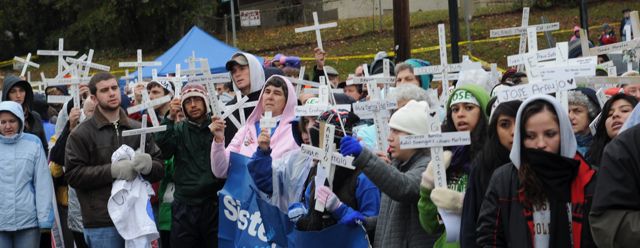
The high point of the weekend was the Sunday procession of thousands, each carrying a white cross with the name of a slain Latin American peasant, worker or child, and a number of priests and nuns, including Salvadoran Archbishop Oscar Romero, slain by those trained in Fort Benning's SOA facility. Teams of singers mournfully sang the names and ages, and after each one, everyone raised their crosses, and answered with the classic salute of the living to those who have fallen in battle: "Presente!"
The procession lasted for hours as the column of mourners bearing crosses of the dead walked from the front of the stage up one side of the street to the police barriers and back down the other side of the street to the back of the stage. There they placed the crosses into the chain link fence blocking the entrance to the military base. Many mourners cried. Some raised their fists. Some knelt in prayer or meditation as the singing of the names and the chant of "Presente!" continued. Behind the stage a theatre group staged a scene of murdered members of a religious order, their bodies spattered with blood. Others snapped pictures or stood quietly.
As soon as a young man approached the fence military loudspeakers surrounding the entire area blared a recorded message asserting that the military base was a legal entity and operated under the U.S. Constitution and that crossing onto base property was a federal crime. Cheering and applause roared up as the young man climbed the fence, crossed the barbed wire top and dropped onto the grass. Before he could reach the second fence he was apprehended and cuffed by the military police. On the east side of the street up the hillside crowds of neighborhood residents stood silently in their yards observing the ceremony of remembrance.

Over its 59 years of existence, the SOA, frequently dubbed the "School of Assassins," has left a trail of blood and suffering. It has trained over 60,000 Latin American soldiers in counterinsurgency techniques, sniper training, commando and psychological warfare, military intelligence and interrogation tactics. Among those targeted are educators, union organizers, religious workers, student leaders, and others who work for the rights of the poor. Hundreds of thousands of Latin Americans have been tortured, raped, assassinated, "disappeared," massacred, and forced into being refugees.
"I am a different person, and so is everyone else who confronted this evil," said Randy Shannon from Beaver County, PA. "We walked in a procession singing out the name of each and every one of the thousands of Latin American men, women, and children, mostly working people and their spiritual brothers and sisters. It was a remembrance of their loss and our shame."
Shannon is a national committee member of the Committees of Correspondence for Democracy and Socialism. Together with Jim Skillman and Steve Wise from Atlanta, along with me, we comprised a team of four who worked the CCDS book and literature table, as well as taking part in many of the events. Randy made the long drive from Pennsylvania the day before, so we were early arrivals on Saturday, Nov. 20. We managed to get our van unloaded and table set up before 9am.
The School of the Americas Watch team had the area well organized. A strikingly decorated stage was constructed near the double barbed wire topped fences blocking the entrance to Fort Benning. The stage was at the foot of a 10-block-long section of a street that was had been blocked off by police. The wide corridor with tall loudspeakers stationed every few blocks, provided excellent acoustics. Homes of local residents were on one side of the corridor, and many had food concessions on their lawns. On the other side of the street was a chain link fence, against which a long line of booths for political groups and vendors were arrayed. On the other side of the chain link fence was a grassy area patrolled by military and local police.
Before long, the buses start arriving. They came from across the South and the Midwest, up to Minnesota, down to Florida, and out to Nebraska. A good number were from small Catholic colleges and universities, and loads of students, along with the nuns, monks and priests who taught them, unloaded with smiles and excitement at being there.
"As an activist since the 1960s," said Atlanta's Jim Skillman, "I find it intoxicating to be in the midst of so many justice-minded young people." A Vietnam veteran, Skillman had joined SDS at Georgia State after leaving the army in 1967, and has been a dedicated labor, peace and human rights organizer ever since.
Other veterans started showing up in batches. They gathered around the 'Courage to Resist' table, a group of today's Iraq and Afghan vets. They were featuring a display defending Private Bradley Manning, facing 50 years in prison for being a whistleblower leaking information about war crimes in Iraq.
A variety of religious forces also began arrives. A group of Presbyterians unfurled a banner. A group of Buddhist monks of Nipponzan Myohoji, Atlanta Dojo walked more than 100 miles as a walking prayer to 'Close the SOA.' They averaged 15 miles per day, staying in churches or supporters' homes. .
Our CCDS table quickly became very busy. We came up with the successful idea of making a thousand small water-applicable 'No to SOA' tattoos, the letters SOA with a red circle and slash. 'Get a free tattoo! Just sign up with your email for our CCDS newsletter!' We were surrounded by eager signers for the entire two days. Naturally, some of the taboo applications turned into longer discussions and book purchases. It was a lively time well spent.
A far larger feature of the weekend than activity at the tables, however, was an ongoing tension shaping up with the police, military security and the FBI, who are all present in force. The strategy of the SOA and local authorities is apparently to find every possible minor transgression to crack down hard on participants, to impose quick and severe penalties for planned civil disobedience, and where no problems exists, to use undercover agent provocateurs to create division and trouble.
The Columbus city police headed the security preparations this year, assisted by the Muscogee County sheriff's and marshal's offices, Fort Benning's own military police force, and a number of undercover agents disguised as protestors.
The agent provocateurs were focused on a planned march to take the SOA Watch protest into downtown Columbus on Saturday afternoon. At a meeting the night before, three individuals kept egging people into the streets. When challenged as to who they were, they then faded away. The next day when the march did take place, a number of the crowd stepped off the sidewalk and into the street at one point. According to the Columbus Ledger-Enquirer:
"Lauren Stinson, an undercover agent with the Metro Narcotics Task Force, testified Sunday that she participated in two meetings with SOA Watch protesters as they planned to step onto Victory Drive Saturday afternoon. All but one of the 22 arrested were found guilty, an SOA Watch organizer said. Stinson followed the group of about 12 people into the southbound lane around 4:45 p.m., blocking traffic and being rounded up with the others on charges including obstruction of a highway and unlawful assembly. Stinson was put in the back of a patrol car and taken to the Muscogee County Jail, but wasn't arrested. She testified before Columbus Recorder's Court Judge Michael Cielinski in some of the 22 cases the judge heard Sunday afternoon."
When defense attorneys tried to question Agent Stinson on the stand to learn more about her team's operation, the judge ruled that she didn't have to answer, and she didn't. For the minor incursion of stepping into the street, each protestor was hit with $5000 in bail and six month jail terms.
"Many of these tactics are not new," said Jake Olzen of the SOA Watch team. "What is new, however, is the intensity, preparation, and specific targeting used by law enforcement authorities to discredit the movement's legitimacy through the use of scare tactics and deterrence. For example, the Columbus Police department had photographs and lists of members of the SOA Watch Legal Collective and were specifically targeting these individuals because of their capacity as organizers and their ability to offer legal support. Charity Ryerson, a former SOA Prisoner of Conscience and Georgetown University law student, was specifically sought out and arrested for her role as an organizer."
Sunday morning began with a march of about 100 veterans, followed by music from the stage, mixed with appeals for bail money for those arrested the day before.
One visitor to our table on Sunday morning was Bob King, the newly elected president of the United Auto Workers. Randy talked to him about the jobs crisis, and sold him our pamphlet on full employment. King has been at the SOA Watch protest many times, and has led a U.S. trade union delegation to El Salvador. This year he was a featured speaker, and took part in the procession with his daughter.
"The SOA has a terrible history," said King from the stage. "Its graduates were involved in some of the worst human rights abuses in South and Central America including the assassination of Archbishop Romero and six Jesuits priests at the University of Central America in San Salvador. Those of us who have democratic rights must be a voice for those less fortunate who do not have a voice because of the terrorism they face."
A speaker from Resistencia in Honduras also detailed some of the atrocities carried out by the Micheletti and Lobo regimes since the June 28 coup. The new Wikileaks exposes may well reveal a less-than-neutral hand by the Obama administration.
Father Roy Bourgeois, when he spoke from the stage, tied the arrests and undercover police efforts over the weekend to the wider efforts by the FBI to target antiwar and solidarity activists with grand jury subpoenas under the guise of 'fighting terrorism.'
"If the FBI is interested in investigating terrorism," said Father Bourgeois, "they should come here to Columbus, Georgia, home of Ft. Benning, where there is the School of the Americas. This really is a well known terrorist training camp, and if we want to get serious about talking about terrorism and closing down terrorist training camps, I would highly recommend that the FBI come right in their backyard....I want to offer my support, as so many of us want to, to our brothers and sisters in the Committee to Stop FBI Repression. What has happened to them can happen to anyone, anyone that is a critic of U.S. foreign policy."
As the speeches concluded and the procession was underway, the planned civil disobedience of climbing the barbed-wire fence into Ft. Benning got underway. This year four people took that step. Two of them, Louie Vitale, OFM, who crossed the line for the fourth time, and David Omondi, of the Los Angeles Catholic Worker who crossed the line for the first time, pleaded 'no contest' and were immediately convicted in federal court. They each received a six month prison sentence from U.S. Magistrate Judge Stephen Hyles. Nancy Smith and Chris Spicer, the two others who crossed over the fence, will go to trial January 5, 2011.
A number of reports noted that this year's SOAW effort was smaller than the peak of 20,000 years back. Part of the reason was that this year's efforts were divided between those who came to Ft Benning, and others who had lobbied Congress earlier this summer. In any case, given the high spirits and determination of those who came this year, the struggle will be ongoing.
Randy Shannon summed it up: "Seeing UAW's Bob King here and hearing his militant speech pledging labor's solidarity with the peace community and Latin America, all working to close this abomination—that gives me hope. Likewise, the thousands of students from small Catholic colleges across the country standing up against murder and torture--that gives me hope as well."
[Carl Davidson is a national co-chair and field organizer for the Committees of Correspondence for Democracy and a webmaster for Beaver County Peace Links. If you like this article, make use of this PayPal button to help with the expenses of producing it.]
Thursday, November 10, 2011
Greece?? Jefferson County!!! ALABAMA
Today's Washington Post article is more like corporate PR damage control:
NOVEMBER 10, 2011
Largest Municipal Bankruptcy Filed
BY KELLY NOLAN
Jefferson County, Ala., which owes more than $3 billion on a failed sewer deal, filed Wednesday for what would be the largest municipal bankruptcy in U.S. history after a tentative rescue plan with creditors unraveled.
The county, home to Alabama's biggest city, Birmingham, filed its Chapter 9 petition in U.S. Bankruptcy Court less than an hour after county commissioners voted 4-1 to do so. The document was signed by Commission President David Carrington.
After over three years of diligent efforts toward regaining financial stability, the county has exhausted its options, and additional delays in resolving its financial crisis will further ...
Jefferson was the municipality hardest hit by the 2008 financial unraveling. Adding to the county's challenges were a sewer project marred by public corruption and political pressure to restrain rising sewer bills. At least 21 people have been convicted or pleaded guilty to corruption-related charges in connection with the sewer construction and financing.
The following timeline provides a chronicle of events leading up to today's vote:
The bonds were so-called revenue bonds, backed by sewer fees instead of tax collections. Offering documents estimated the project would cost about $1.5 billion. The expanding scope of the work subsequently pushed the cost to $2.2 billion, putting the system more than $3 billion in debt. Rates rose more than fourfold over 10 years to help cover repayment costs.
The financing -- which converted floating-rate debt into fixed-rate bonds, and then used the derivative to essentially change it back to a variable rate -- left it with a higher interest cost than when it began, she said. She estimated it raised the county's expense by more than $1 million a year, and raised concern that the arrangement involved cronyism, patronage, excessive fees and fraud.
By the end of it, 93 percent carried interest rates that fluctuated along with the market, including $2.1 billion of so- called auction-rate securities. The county tried to offset its risk with interest-rate swaps, under which it received adjustable payments meant to cover the bonds and paid a fixed rate in return. The county entered into 18 swap trades with a notional value of $5.6 billion, with JPMorgan the dominant provider, according to the SEC. Such structured deals involved multiple bank fees for resetting the interest rates on the bonds, providing credit support and selling the swaps.
The bank's fees on the swaps weren't disclosed, the SEC said. JPMorgan overcharged the county on the swaps to cover the cost of more than $8 million in secret payments made to friends of county commissioners who worked for local companies, a step to secure JPMorgan's lead role, according to the SEC.
JPMorgan banker Charles LeCroy, the bank's representative in the Jefferson County deals, was candid with his colleagues about the political influence peddling, according to an SEC complaint.
When a colleague objected that "randomly paying off people that have nothing to do with the deal just doesn't sit well," he replied: "That's the deal -- that's just the price of doing business," according to SEC records.
"You know, I get the impression that people think a bunch of rubes in Alabama shouldn't be smart enough to utilize these swaps," Langford said. "And let there be an understanding: As long as this is a legal instrument, and it drives down costs, if we have to do one tomorrow, I'll do it again."
Without top credit ratings on the insurers, buyers including money-market funds couldn't hold the county's bonds. Concerned investors dumped them en masse. Banks, seeking to shore up their own cash reserves amid the financial crisis, stop stepping in to buy unwanted auction-rate securities. Many auctions fail, leaving Jefferson to pay penalty interest rates. As central banks slash lending rates, the payments received under the swaps fall instead of increasing, adding to the costs.
JPMorgan and other banks that agreed to buy a portion of the bonds in return for a fee are protected by contracts that required the county to pay off $850 million of the debt in four years, instead of as long as 40 years, as the county had planned. When the bonds were cut to junk, the county faced the risk they could be forced to pay hundreds of millions in fees to escape from the swaps.
Bankruptcy became a possibility as the county begins relying on a series of standstill agreements with banks to stave off financial collapse.
Part of the settlement includes forfeiting $647 million in fees Jefferson County would owe to escape from the swaps, which had kept officials from refinancing. That was of little help because the county cast its creditworthiness in doubt by defaulting on payments, making it unable to borrow on its own.
Former Jefferson County Commissioner Mary Buckelew is sentenced to three years probation and is fined $20,000 after pleading guilty to charges that she lied to a federal grand jury about accepting designer shoes, a purse and a spa trip from Blount during bond-related trips to New York.
Looting Main Street
How the nation's biggest banks are ripping off American cities with the same predatory deals that brought down Greece
By Matt Taibbi -- March 31, 2010 8:15 AM ET
If you want to know what life in the Third World is like, just ask Lisa Pack, an administrative assistant who works in the roads and transportation department in Jefferson County, Alabama. Pack got rudely introduced to life in post-crisis America last August, when word came down that she and 1,000 of her fellow public employees would have to take a little unpaid vacation for a while. The county, it turned out, was more than $5 billion in debt — meaning that courthouses, jails and sheriff's precincts had to be closed so that Wall Street banks could be paid.
Wall Street's Bailout Hustle
As public services in and around Birmingham were stripped to the bone, Pack struggled to support her family on a weekly unemployment check of $260. Nearly a fourth of that went to pay for her health insurance, which the county no longer covered. She also fielded calls from laid-off co-workers who had it even tougher. I'd be on the phone sometimes until two in the morning, she says. I had to talk more than one person out of suicide. For some of the men supporting families, it was so hard — foreclosure, bankruptcy. I'd go to bed at night, and I'd be in tears.
This article appeared in the April 15, 2010 issue of Rolling Stone. The issue is available in the online archive.
Homes stood empty, businesses were boarded up, and parts of already-blighted Birmingham began to take on the feel of a ghost town. There were also a few bills that were unique to the area — like the $64 sewer bill that Pack and her family paid each month. Yeah, it went up about 400 percent just over the past few years, she says.
Wall Street's Naked Swindle
The sewer bill, in fact, is what cost Pack and her co-workers their jobs. In 1996, the average monthly sewer bill for a family of four in Birmingham was only $14.71 — but that was before the county decided to build an elaborate new sewer system with the help of out-of-state financial wizards with names like Bear Stearns, Lehman Brothers, Goldman Sachs and JP Morgan Chase. The result was a monstrous pile of borrowed money that the county used to build, in essence, the world's grandest toilet — the Taj Mahal of sewer-treatment plants is how one county worker put it. What happened here in Jefferson County would turn out to be the perfect metaphor for the peculiar alchemy of modern oligarchical capitalism: A mob of corrupt local officials and morally absent financiers got together to build a giant device that converted human shit into billions of dollars of profit for Wall Street — and misery for people like Lisa Pack.
And once the giant shit machine was built and the note on all that fancy construction started to come due, Wall Street came back to the local politicians and doubled down on the scam. They showed up in droves to help the poor, broke citizens of Jefferson County cut their toilet finance charges using a blizzard of incomprehensible swaps and refinance schemes — schemes that only served to postpone the repayment date a year or two while sinking the county deeper into debt. In the end, every time Jefferson County so much as breathed near one of the banks, it got charged millions in fees. There was so much money to be made bilking these dizzy Southerners that banks like JP Morgan spent millions paying middlemen who bribed — yes, that's right, bribed, criminally bribed — the county commissioners and their buddies just to keep their business. Hell, the money was so good, JP Morgan at one point even paid Goldman Sachs $3 million just to back the fuck off, so they could have the rubes of Jefferson County to fleece all for themselves.
Birmingham became the poster child for a new kind of giant-scale financial fraud, one that would threaten the financial stability not only of cities and counties all across America, but even those of entire countries like Greece. While for many Americans the financial crisis remains an abstraction, a confusing mess of complex transactions that took place on a cloud high above Manhattan sometime in the mid-2000s, in Jefferson County you can actually see the rank criminality of the crisis economy with your own eyes; the monster sticks his head all the way out of the water. Here you can see a trail that leads directly from a billion-dollar predatory swap deal cooked up at the highest levels of America's biggest banks, across a vast fruited plain of bribes and felonies — the price of doing business, as one JP Morgan banker says on tape — all the way down to Lisa Pack's sewer bill and the mass layoffs in Birmingham.
Once you follow that trail and understand what took place in Jefferson County, there's really no room left for illusions. We live in a gangster state, and our days of laughing at other countries are over. It's our turn to get laughed at. In Birmingham, lots of people have gone to jail for the crime: More than 20 local officials and businessmen have been convicted of corruption in federal court. Last October, right around the time that Lisa Pack went back to work at reduced hours, Birmingham's mayor was convicted of fraud and money-laundering for taking bribes funneled to him by Wall Street bankers — everything from Rolex watches to Ferragamo suits to cash. But those who greenlighted the bribes and profited most from the scam remain largely untouched. It never gets back to JP Morgan, says Pack.
If you want to get all Glenn Beck about it, you could lay the blame for this entire mess at the feet of weepy, tree-hugging environmentalists. It all started with the Cahaba River, the longest free-flowing river in the state of Alabama. The tributary, which winds its way through Birmingham before turning diagonally to empty out near Selma, is home to more types of fish per mile than any other river in America and shelters 64 rare and imperiled species of plants and animals. It's also the source of one of the worst municipal financial disasters in American history.
Back in the early 1990s, the county's sewer system was so antiquated that it was leaking raw sewage directly into the Cahaba, which also supplies the area with its drinking water. Joined by well — intentioned citizens from the Cahaba River Society, the EPA sued the county to force it to comply with the Clean Water Act. In 1996, county commissioners signed a now-infamous consent decree agreeing not just to fix the leaky pipes but to eliminate all sewer overflows — a near-impossible standard that required the county to build the most elaborate, ecofriendly, expensive sewer system in the history of the universe. It was like ordering a small town in Florida that gets a snowstorm once every five years to build a billion-dollar fleet of snowplows.
The original cost estimates for the new sewer system were as low as $250 million. But in a wondrous demonstration of the possibilities of small-town graft and contract-padding, the price tag quickly swelled to more than $3 billion. County commissioners were literally pocketing wads of cash from builders and engineers and other contractors eager to get in on the project, while the county was forced to borrow obscene sums to pay for the rapidly spiraling costs. Jefferson County, in effect, became one giant, TV-stealing, unemployed drug addict who borrowed a million dollars to buy the mother of all McMansions — and just as it did during the housing bubble, Wall Street made a business of keeping the crook in his house. As one county commissioner put it, We're like a guy making $50,000 a year with a million-dollar mortgage.
To reassure lenders that the county would pay its mortgage, commissioners gave the finance director — an unelected official appointed by the president of the commission — the power to automatically raise sewer rates to meet payments on the debt. The move brought in billions in financing, but it also painted commissioners into a corner. If costs continued to rise — and with practically every contractor in Alabama sticking his fingers on the scale, they were rising fast — officials would be faced with automatic rate increases that would piss off their voters. (By 2003, annual interest on the sewer deal had reached $90 million.) So the commission reached out to Wall Street, looking for creative financing tools that would allow it to reduce the county's staggering debt payments.
Wall Street was happy to help. First, it employed the same trick it used to fuel the housing crisis: It switched the county from a fixed rate on the bonds it had issued to finance the sewer deal to an adjustable rate. The refinancing meant lower interest payments for a couple of years — followed by the risk of even larger payments down the road. The move enabled county commissioners to postpone the problem for an election season or two, kicking it to a group of future commissioners who would inevitably have to pay the real freight.
But then Wall Street got really creative. Having switched the county to a variable interest rate, it offered commissioners a crazy deal: For an extra fee, the banks said, we'll allow you to keep paying a fixed rate on your debt to us. In return, we'll give you a variable amount each month that you can use to pay off all that variable-rate interest you owe to bondholders.
In financial terms, this is known as a synthetic rate swap — the spidery creature you might have read about playing a role in bringing down places like Greece and Milan. On paper, it made sense: The county got the stability of a fixed rate, while paying Wall Street to assume the risk of the variable rates on its bonds. That's the synthetic part. The trouble lies in the rate swap. The deal only works if the two variable rates — the one you get from the bank, and the one you owe to bondholders — actually match. It's like gambling on the weather. If your bondholders are expecting you to pay an interest rate based on the average temperature in Alabama, you don't do a rate swap with a bank that gives you back a rate pegged to the temperature in Nome, Alaska.
Not unless you're a fucking moron. Or your banker is JP Morgan.
In a small office in a federal building in downtown Birmingham, just blocks from where civil rights demonstrators shut down the city in 1963, Assistant U.S. Attorney George Martin points out the window. He's pointing in the direction of the Tutwiler Hotel, once home to one of the grandest ballrooms in the South but now part of the Hampton Inn chain.
It was right around the corner here, at the hotel, Martin says. That's where they met — that's where this all started.
They means Charles LeCroy and Bill Blount, the two principals in what would become the most important of all the corruption cases in Jefferson County. LeCroy was a banker for JP Morgan, serving as managing director of the bank's southeast regional office. Blount was an Alabama wheeler-dealer with close friends on the county commission. For years, when Wall Street banks wanted to do business with municipalities, whether for bond issues or rate swaps, it was standard practice to reach out to a local sleazeball like Blount and pay him a shitload of money to help seal the deal. Banks would pay some local consultant, and the consultant would then funnel money to the politician making the decision, says Christopher Taylor, the former head of the board that regulates municipal borrowing. Back in the 1990s, Taylor pushed through a ban on such backdoor bribery. He also passed a ban on bankers contributing directly to politicians they do business with — a move that sparked a lawsuit by one aggrieved sleazeball, who argued that halting such legalized graft violated his First Amendment rights. The name of that pissed-off banker? It was the one and only Bill Blount, Taylor says with a laugh.
Blount is a stocky, stubby-fingered Southerner with glasses and a pale, pinched face — if Norman Rockwell had ever done a painting titled Small-Town Accountant Taking Enormous Dump, it would look just like Blount. LeCroy, his sugar daddy at JP Morgan, is a tall, bloodless, crisply dressed corporate operator with a shiny bald head and silver side patches — a cross between Skeletor and Michael Stipe.
The scheme they operated went something like this: LeCroy paid Blount millions of dollars, and Blount turned around and used the money to buy lavish gifts for his close friend Larry Langford, the now-convicted Birmingham mayor who at the time had just been elected president of the county commission. (At one point Blount took Langford on a shopping spree in New York, putting $3,290 worth of clothes from Zegna on his credit card.) Langford then signed off on one after another of the deadly swap deals being pushed by LeCroy. Every time the county refinanced its sewer debt, JP Morgan made millions of dollars in fees. Even more lucrative, each of the swap contracts contained clauses that mandated all sorts of penalties and payments in the event that something went wrong with the deal. In the mortgage business, this process is known as churning: You keep coming back over and over to refinance, and they keep churning you for more and more fees. The transactions were complex, but the scheme was simple, said Robert Khuzami, director of enforcement for the SEC. Senior JP Morgan bankers made unlawful payments to win business and earn fees.
Given the shitload of money to be made on the refinancing deals, JP Morgan was prepared to pay whatever it took to buy off officials in Jefferson County. In 2002, during a conversation recorded in Nixonian fashion by JP Morgan itself, LeCroy bragged that he had agreed to funnel payoff money to a pair of local companies to secure the votes of two county commissioners. Look, the commissioners told him, if we support the synthetic refunding, you guys have to take care of our two firms. LeCroy didn't blink. Whatever you want, he told them. If that's what you need, that's what you get. Just tell us how much.
Just tell us how much. That sums up the approach that JP Morgan took a few months later, when Langford announced that his good buddy Bill Blount would henceforth be involved with every financing transaction for Jefferson County. From JP Morgan's point of view, the decision to pay off Blount was a no-brainer. But the bank had one small problem: Goldman Sachs had already crawled up Blount's trouser leg, and the broker was advising Langford to pick them as Jefferson County's investment bank.
The solution they came up with was an extraordinary one: JP Morgan cut a separate deal with Goldman, paying the bank $3 million to fuck off, with Blount taking a $300,000 cut of the side deal. Suddenly Goldman was out and JP Morgan was sitting in Langford's lap. In another conversation caught on tape, LeCroy joked that the deal was his philanthropic work, since the payoff amounted to a charitable donation to Goldman Sachs in return for taking no risk.
That such a blatant violation of anti-trust laws took place and neither JP Morgan nor Goldman have been prosecuted for it is yet another mystery of the current financial crisis. This is an open-and-shut case of anti-competitive behavior, says Taylor, the former regulator.
With Goldman out of the way, JP Morgan won the right to do a $1.1 billion bond offering — switching Jefferson County out of fixed-rate debt into variable-rate debt — and also did a corresponding $1.1 billion deal for a synthetic rate swap. The very same day the transaction was concluded, in May 2003, LeCroy had dinner with Langford and struck a deal to do yet another bond-and-swap transaction of roughly the same size. This time, the terms of the payoff were spelled out more explicitly. In a hilarious phone call between LeCroy and Douglas MacFaddin, another JP Morgan official, the two bankers groaned aloud about how much it was going to cost to satisfy Blount:
LeCroy: I said, Commissioner Langford, I'll do that because that's your suggestion, but you gotta help us keep him under control. Because when you give that guy a hand, he takes your arm. You know?
MacFaddin: [Laughing] Yeah, you end up in the wood-chipper.
All told, JP Morgan ended up paying Blount nearly $3 million for performing no known services, in the words of the SEC. In at least one of the deals, Blount made upward of 15 percent of JP Morgan's entire fee. When I ask Taylor what a legitimate consultant might earn in such a circumstance, he laughs. What's a 'legitimate consultant' in a case like this? He made this money for doing jack shit.
As the tapes of LeCroy's calls show, even officials at JP Morgan were incredulous at the money being funneled to Blount. How does he get 15 percent? one associate at the bank asks LeCroy. For doing what? For not messing with us?
Not messing with us, LeCroy agrees. It's a lot of money, but in the end, it's worth it on a billion-dollar deal.
That's putting it mildly: The deals wound up being the largest swap agreements in JP Morgan's history. Making matters worse, the payoffs didn't even wind up costing the bank a dime. As the SEC explained in a statement on the scam, JP Morgan passed on the cost of the unlawful payments by charging the county higher interest rates on the swap transactions. In other words, not only did the bank bribe local politicians to take the sucky deal, they got local taxpayers to pay for the bribes. And because Jefferson County had no idea what kind of deal it was getting on the swaps, JP Morgan could basically charge whatever it wanted. According to an analysis of the swap deals commissioned by the county in 2007, taxpayers had been overcharged at least $93 million on the transactions.
JP Morgan was far from alone in the scam: Virtually everyone doing business in Jefferson County was on the take. Four of the nation's top investment banks, the very cream of American finance, were involved in one way or another with payoffs to Blount in their scramble to do business with the county. In addition to JP Morgan and Goldman Sachs, Bear Stearns paid Langford's bagman $2.4 million, while Lehman Brothers got off cheap with a $35,000 arranger's fee. At least a dozen of the county's contractors were also cashing in, along with many of the county commissioners. If you go into the county courthouse, says Michael Morrison, a planner who works for the county, there's a gallery of past commissioners on the wall. On the top row, every single one of 'em but two has been investigated, indicted or convicted. It's a joke.
The crazy thing is that such arrangements — where some local scoundrel gets a massive fee for doing nothing but greasing the wheels with elected officials — have been taking place all over the country. In Illinois, during the Upper Volta-esque era of Rod Blagojevich, a Republican political consultant named Robert Kjellander got 10 percent of the entire fee Bear Stearns earned doing a bond sale for the state pension fund. At the start of Obama's term, Bill Richardson's Cabinet appointment was derailed for a similar scheme when he was governor of New Mexico. Indeed, one reason that officials in Jefferson County didn't know that the swaps they were signing off on were shitty was because their adviser on the deals was a firm called CDR Financial Products, which is now accused of conspiring to overcharge dozens of cities in swap transactions. According to a federal antitrust lawsuit, CDR is basically a big-league version of Bill Blount — banks tossed money at the firm, which in turn advised local politicians that they were getting a good deal. It was basically, you pay CDR, and CDR helps push the deal through, says Taylor.
In the end, though, all this bribery and graft was just the table-setter for the real disaster. In taking all those bribes and signing on to all those swaps, the commissioners in Jefferson County had basically started the clock on a financial time bomb that, sooner or later, had to explode. By continually refinancing to keep the county in its giant McMansion, the commission had managed to push into the future that inevitable day when the real bill would arrive in the mail. But that's where the mortgage analogy ends — because in one key area, a swap deal differs from a home mortgage. Imagine a mortgage that you have to keep on paying even after you sell your house. That's basically how a swap deal works. And Jefferson County had done 23 of them. At one point, they had more outstanding swaps than New York City.
Judgment Day was coming — just like it was for the Delaware River Port Authority, the Pennsylvania school system, the cities of Detroit, Chicago, Oakland and Los Angeles, the states of Connecticut and Mississippi, the city of Milan and nearly 500 other municipalities in Italy, the country of Greece, and God knows who else. All of these places are now reeling under the weight of similarly elaborate and ill-advised swaps — and if what happened in Jefferson County is any guide, hoo boy. Because when the shit hit the fan in Birmingham, it really hit the fan.
For Jefferson County, the deal blew up in early 2008, when a dizzying array of penalties and other fine-print poison worked into the swap contracts started to kick in. The trouble began with the housing crash, which took down the insurance companies that had underwritten the county's bonds. That rendered the county's insurance worthless, triggering clauses in its swap contracts that required it to pay off more than $800 million of its debt in only four years, rather than 40. That, in turn, scared off private lenders, who were no longer interested in bidding on the county's bonds. The banks were forced to make up the difference — a service for which they charged enormous penalties. It was as if the county had missed a payment on its credit card and woke up the next morning to find its annual percentage rate jacked up to a million percent. Between 2008 and 2009, the annual payment on Jefferson County's debt jumped from $53 million to a whopping $636 million.
It gets worse. Remember the swap deal that Jefferson County did with JP Morgan, how the variable rates it got from the bank were supposed to match those it owed its bondholders? Well, they didn't. Most of the payments the county was receiving from JP Morgan were based on one set of interest rates (the London Interbank Exchange Rate), while the payments it owed to its bondholders followed a different set of rates (a municipal-bond index). Jefferson County was suddenly getting far less from JP Morgan, and owing tons more to bondholders. In other words, the bank and Bill Blount made tens of millions of dollars selling deals to local politicians that were not only completely defective, but blew the entire county to smithereens.
And here's the kicker. Last year, when Jefferson County, staggered by the weight of its penalties, was unable to make its swap payments to JP Morgan, the bank canceled the deal. That triggered one-time termination fees of — yes, you read this right — $647 million. That was money the county would owe no matter what happened with the rest of its debt, even if bondholders decided to forgive and forget every dime the county had borrowed. It was like the herpes simplex of loans — debt that does not go away, ever, for as long as you live. On a sewer project that was originally supposed to cost $250 million, the county now owed a total of $1.28 billion just in interest and fees on the debt. Imagine paying $250,000 a year on a car you purchased for $50,000, and that's roughly where Jefferson County stood at the end of last year.
Last November, the SEC charged JP Morgan with fraud and canceled the $647 million in termination fees. The bank agreed to pay a $25 million fine and fork over $50 million to assist displaced workers in Jefferson County. So far, the county has managed to avoid bankruptcy, but the sewer fiasco had downgraded its credit rating, triggering payments on other outstanding loans and pushing Birmingham toward the status of an African debtor state. For the next generation, the county will be in a constant fight to collect enough taxes just to pay off its debt, which now totals $4,800 per resident.
The city of Birmingham was founded in 1871, at the dawn of the Southern industrial boom, for the express purpose of attracting Northern capital — it was even named after a famous British steel town to burnish its entrepreneurial cred. There's a gruesome irony in it now lying sacked and looted by financial vandals from the North. The destruction of Jefferson County reveals the basic battle plan of these modern barbarians, the way that banks like JP Morgan and Goldman Sachs have systematically set out to pillage towns and cities from Pittsburgh to Athens. These guys aren't number-crunching whizzes making smart investments; what they do is find suckers in some municipal-finance department, corner them in complex lose-lose deals and flay them alive. In a complete subversion of free-market principles, they take no risk, score deals based on political influence rather than competition, keep consumers in the dark — and walk away with big money. It's not high finance, says Taylor, the former bond regulator. It's low finance. And even if the regulators manage to catch up with them billions of dollars later, the banks just pay a small fine and move on to the next scam. This isn't capitalism. It's nomadic thievery.
This article originally appeared in RS 1102 from April 15, 2010. This issue and the rest of the Rolling Stone archives are available via Rolling Stone Plus, Rolling Stone's premium subscription plan.